American Single Malt Whiskey: Read the Label
- American single malt whiskey now has a federal definition
- What does the American single malt rule require?
- Does single malt mean single barrel?
- Must American single malt use new charred oak?
- Is there a minimum age?
- How does American single malt differ from malt whiskey?
- What does caramel coloring disclosure mean?
- Why might a pre-2030 bottle not match the new definition?
- What can the bottle tell you, and what still needs research?
- A six-step bottle check
- Sources
American single malt whiskey now has a federal definition
American single malt whiskey is a U.S. whiskey made from a fermented mash of 100 percent malted barley, distilled at no more than 160 proof at one U.S. distillery, and stored in the United States in oak barrels holding no more than 700 liters. Those barrels may be used oak, uncharred new oak, or charred new oak. The finished whiskey must be bottled at 80 proof or higher.
That definition became effective on January 19, 2025. It gives the phrase a precise federal meaning instead of leaving the reader to reconstruct it from a producer's house language. The regulation spells the type as “American single malt whisky,” although federal rules permit either whisky or whiskey as the general spelling.
The useful reading habit is to separate what the designation guarantees from everything it leaves open. “American single malt” settles the grain, country, distillation site, distillation ceiling, barrel material and maximum barrel capacity. It does not tell you the barley variety, still design, barrel history, age, batch size, bottling site, or likely flavor.
What does the American single malt rule require?
Current 27 CFR 5.143 puts the requirements in the federal table of whiskey types. Read together with the general whiskey definition and the TTB's American single malt overview, the label means this:
| Requirement | What the rule says | What a label reader can conclude |
|---|---|---|
| Grain | Fermented mash of 100 percent malted barley | No corn, rye, wheat, or unmalted barley is part of the mash |
| Place | Produced in the United States; mashed, distilled, and aged in the United States | The designation is a U.S. standard tied to U.S. production |
| Distillery | Distilled at the same U.S. distillery | The distillate cannot be assembled from multiple distilleries and keep this type designation |
| Distillation proof | 160 proof or less | It is distilled at no more than 80 percent alcohol by volume |
| Barrel | Used, charred new, or uncharred new oak | New charred oak is one option, not a universal requirement |
| Barrel capacity | 700 liters maximum | Larger oak containers do not satisfy this storage specification |
| Storage location | Stored only in the United States | Qualifying barrel aging takes place in the United States |
| Bottling strength | At least 80 proof | The bottle contains at least 40 percent alcohol by volume |
| Added material | No neutral spirits; no coloring, flavoring, or blending material except disclosed caramel coloring | Caramel coloring is permitted only when its use appears on the label |
The “same distillery” language applies to distillation. The rule separately requires U.S. mashing and U.S. storage; it does not say those two operations must occur on the distillery premises. Likewise, the standard does not require bottling at the distillery. A label should not be made to promise more geographic precision than the regulation supplies.
Does single malt mean single barrel?
No. In this designation, “single” identifies one distillery, not one barrel, one batch, one field of barley, or one bottling run. The rule does not prevent a producer from combining qualifying barrels made at that distillery.
That distinction matters because single barrel answers a different question. A single-barrel release is drawn from one barrel; an American single malt may be a marriage of many qualifying barrels. The phrase also does not disclose whether every barrel followed an identical maturation path. One batch could combine barrels with different ages or prior uses, provided the finished product and each relevant component still comply with the applicable rules.
Do not turn “100 percent malted barley” into “one barley.” The federal grain rule describes the mash by grain form, not cultivar, farm, harvest, malting specification, or kilning method. Those details need a producer statement or technical sheet.
Must American single malt use new charred oak?
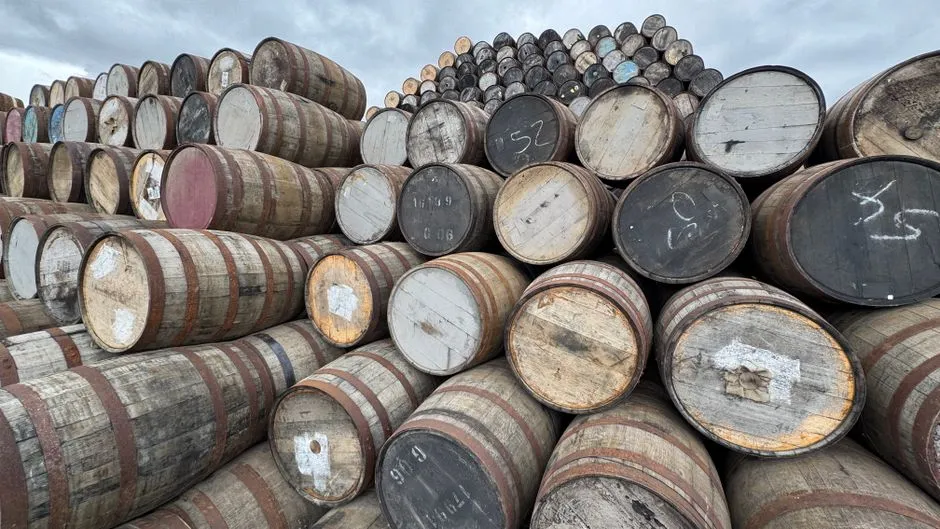
No. This is one of the cleanest differences between American single malt and several familiar American whiskey types. Federal rules permit three oak routes for American single malt:
- used oak barrels;
- uncharred new oak barrels; or
- charred new oak barrels.
The barrel cannot exceed 700 liters, but the standard does not prescribe a minimum barrel size. It also does not name a required previous fill for used oak, a char level, a toast level, or a minimum number of barrels.
This flexibility makes the words around the designation useful. A producer may identify a prior barrel use, a finish, a char treatment, or a cask program, but those are additional claims rather than facts encoded in “American single malt.” Verify them against the producer's current documentation. A broad phrase such as “oak matured” cannot tell you which of the three permitted routes was used.
The same restraint applies to flavor. Used oak, uncharred new oak, and charred new oak can create different maturation conditions, but a barrel category alone does not guarantee smoke, vanilla, fruit, sweetness, dryness, or intensity. Spirit cut, fermentation, barrel history, climate, warehouse position, time, proof, and blending decisions remain part of the result.
Is there a minimum age?
The basic American single malt type has no numerical minimum age in its standard of identity. It must be stored in a permitted oak barrel, but the word American single malt alone does not establish two, three, or four years.
“Straight American single malt whisky” is different. Section 5.143 requires at least two years in the permitted oak barrels before the optional word straight may be used. Unlike straight bourbon or straight rye, straight American single malt is not confined to charred new oak; its row retains the American-single-malt options of used, charred new, or uncharred new oak, with the 700-liter limit.
Age-statement rules add another layer. Under current 27 CFR 5.74, whiskey aged less than four years generally must carry an age statement. For whiskey without neutral spirits, a single age statement gives the age of the youngest whiskey in the product. Whiskey four years old or older may generally omit the number unless other age or maturity language triggers a statement.
So the words answer different questions:
- American single malt establishes the production type but not a numbered minimum age.
- Straight American single malt establishes at least two years in qualifying oak.
- An age statement gives the applicable minimum age under the labeling rules; it is not an average.
Our guide to whiskey age statements explains the youngest-component rule and the under-four labeling threshold in detail.
How does American single malt differ from malt whiskey?
The shorter designation malt whisky is already a separate federal type. It requires a fermented mash containing at least 51 percent malted barley, distillation at 160 proof or less, and storage at 125 proof or less in charred new oak. American single malt raises the malted-barley share to 100 percent, requires distillation at one U.S. distillery, and permits used, uncharred new, or charred new oak barrels up to 700 liters.
That means neither phrase is a casual abbreviation for the other. A whiskey made from 60 percent malted barley may meet the malt-whiskey grain threshold but cannot meet the 100 percent mash requirement for American single malt. Conversely, a qualifying American single malt matured in used oak would not meet the charred-new-oak storage specification in the federal malt-whiskey row.
The difference is regulatory, not a quality ranking. One designation is not automatically better, more traditional, or more flavorful. They describe different production boundaries.
What does caramel coloring disclosure mean?
The American single malt rule bars neutral spirits and bars coloring, flavoring, or blending materials except caramel coloring. If caramel coloring is used, the exception applies only when that use is disclosed on the label.
That gives the reader a narrow, verifiable conclusion. A disclosure means caramel coloring was used; no disclosure on a compliant current label means it was not used under this exception. The rule does not turn color into an age gauge. Darker whiskey is not necessarily older, and two bottles' color difference cannot by itself identify their barrels, age, or concentration.
Look for the disclosure anywhere the mandatory information is presented, not just in the largest front-label type. TTB's distilled spirits labeling guide lists class or type, alcohol content, age statements when applicable, and color-ingredient disclosures when applicable among the information a label reader may need to assemble.
Why might a pre-2030 bottle not match the new definition?
The final rule includes a five-year transition. A label using “American single malt whisky” or “straight American single malt whisky” may remain on spirits bottled before January 19, 2030, if the product conforms to the federal standards that applied before January 19, 2025.
This is a date-specific exception, not a permanent second definition. It exists because labels and stocks were already in commerce when the new standard took effect. If an older bottling appears to conflict with the new checklist, inspect the bottling context and producer documentation before declaring the label noncompliant. The decisive date in the transition is when the spirits were bottled, not when a shopper found the bottle.
For current releases outside that transition, use the current standard. Do not treat old marketing copy, a retailer's category tag, or a search-result snippet as better evidence than the actual label and current producer materials.
What can the bottle tell you, and what still needs research?
A disciplined label read has two columns.
The designation and mandatory statements can establish:
- the American-single-malt production boundaries;
- the bottle's alcohol by volume and, if shown, proof;
- a required or optional age statement;
- the use of caramel coloring, when applicable;
- the responsible bottler or producer information shown on the label.
Producer documentation may be needed for:
- barley variety, growing region, maltster, or malt specification;
- whether the malt was peated, smoked, roasted, or otherwise treated;
- fermentation times and yeast choices;
- pot, column, or hybrid still details;
- barrel origin, previous contents, char or toast treatment;
- batch size, number of barrels, warehouse path, and finishing sequence;
- filtration and dilution choices before bottling.
If a producer does not publish one of those details, mark it unknown. Do not fill the space with a category stereotype. The designation was designed to make some facts dependable; its usefulness depends on not pretending it answers every production question.
The broader whiskey-label guide shows where to find the class or type, age, proof, producer line, and optional production claims.
A six-step bottle check
- Find the exact type designation. Confirm that the label says American single malt whisky or whiskey, not merely single malt in descriptive copy.
- Read the proof or ABV. The type has an 80-proof bottling floor, but the actual release may be higher.
- Look for “straight” and an age statement. Straight sets a two-year floor; an age number gives more specific information where present.
- Check for a caramel-color disclosure. Do not use appearance as a substitute.
- Separate required facts from producer claims. Barrel history, malt treatment, still type, and batch construction need their own evidence.
- Record unknowns honestly. A missing detail is not permission to infer a romantic production story.
American single malt is therefore a useful label, not a complete biography. It tells you that all-malted-barley whiskey crossed a defined U.S. production path at one distillery. The rest of the bottle still rewards careful reading.
For adults of legal drinking age. Enjoy whiskey responsibly.